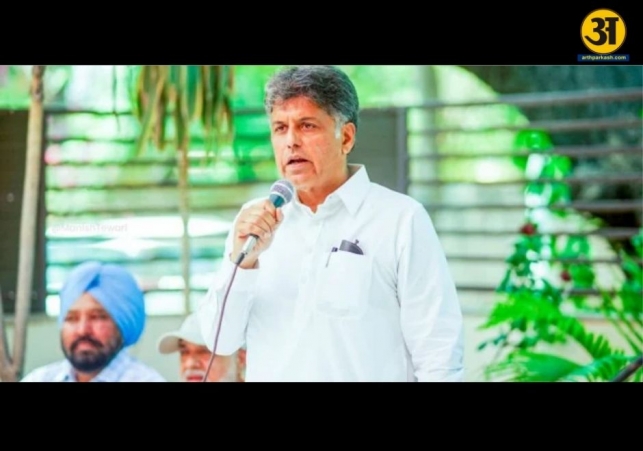
Tewari quits sub-panel over selection anomalies
Chandigarh: Tewari quits advisory council’s sub-panel over ‘anomalies’ in selections
- By Gurmehar --
- Monday, 14 Jul, 2025
Congress Member of Parliament (MP) Manish Tewari has resigned as the chairperson of one of the sub-committees under Chandigarh’s Administrator’s Advisory Council. He was leading the sub-committee on art, culture, tourism, and heritage preservation. His resignation came just two days after the Union Territory (UT) administration formed 10 standing sub-committees under the advisory council.
Tewari’s main concern was that seven out of the ten sub-committees were headed by people belonging to only one political party—the BJP. In a letter to Punjab Governor and Chandigarh Administrator Gulab Chand Kataria, he wrote that this was unfair and showed political bias. He suggested that instead of him, local Congress leader Harmohinder Singh Lucky should be appointed chairperson of the sub-committee.
Tewari said he was surprised to see that while presidents of other political parties in Chandigarh were appointed as chairpersons of different sub-committees, the Congress party’s Chandigarh president HS Lucky was only made a member, not a chairperson. He called this an “anomaly” and said that such unfairness should be corrected.
Calls for expert leadership
In his letter, Tewari also expressed the opinion that ideally, political people should not be heading such committees at all. Instead, he said, subject experts and professionals with deep knowledge of the area should lead these panels. Chandigarh has many such people, and their experience and knowledge could benefit the city, he said.
Even though he accepted the administrator’s decision to appoint political leaders as committee heads, Tewari insisted that all major political parties should be represented fairly. By appointing Lucky in his place, the Congress would be treated more equally with other political parties, he said.
However, his resignation sparked criticism from BJP leaders. Ravi Rawat, the BJP’s media head in Chandigarh, said that Tewari’s resignation was only for show. He accused Tewari of running away from responsibility and said that instead of stepping down, the MP should have worked to improve Chandigarh’s art, culture, and tourism.
Rawat added that these committee positions are not games to be passed around at will. He said Tewari’s resignation was unfair to the people of Chandigarh who had hopes from him.
ALSO READ: Chandigarh-bound bus crashes into truck near Karnal, driver killed
ALSO READ: Chandigarh: ‘Courage, dedication & sacrifice’ — army pays tribute to Capt Batra
Every two years, the UT administrator forms an advisory council with about 60 members. The council includes people from various professional backgrounds and is expected to guide the administration on important policy and development issues. However, opposition parties have long claimed that most members are usually chosen from the BJP, which has been the ruling party at the Centre for the past 10 years.
This time as well, according to the orders issued by the UT home secretary, out of the ten sub-committees formed, seven are chaired by leaders connected to the BJP. These committees have specific topics to focus on, and each one has a chairperson, members, and a secretary. The committees meet separately to discuss their subjects and share their suggestions before the full Advisory Council meeting, which is led by the UT administrator.
Some of the key appointments to these committees include BJP’s Chandigarh president JP Malhotra, senior leaders like Sanjay Tandon, Satya Pal Jain, Satnam Sandhu, and Gian Chand Gupta. Former mayors Anup Gupta and Subhash Chawla were also appointed as committee heads. Only a few leaders outside the BJP, such as MP Manish Tewari and AAP’s Vijaypal Singh, were made chairpersons of sub-committees.
Tewari’s resignation and complaint about unfair representation once again bring attention to the long-standing issue of political imbalance in such advisory councils. The matter may push the administration to review how appointments are made and whether more non-political experts should be given leadership roles in such important bodies.
Related News